Gluten-free goodness in every bite
Welcome to Fria, the gluten-free bakery
We’re passionate about making gluten-free taste really delicious—from crispy toast to seedy rolls and sweet muffins. For everyday life and celebrations—and every bite in between.
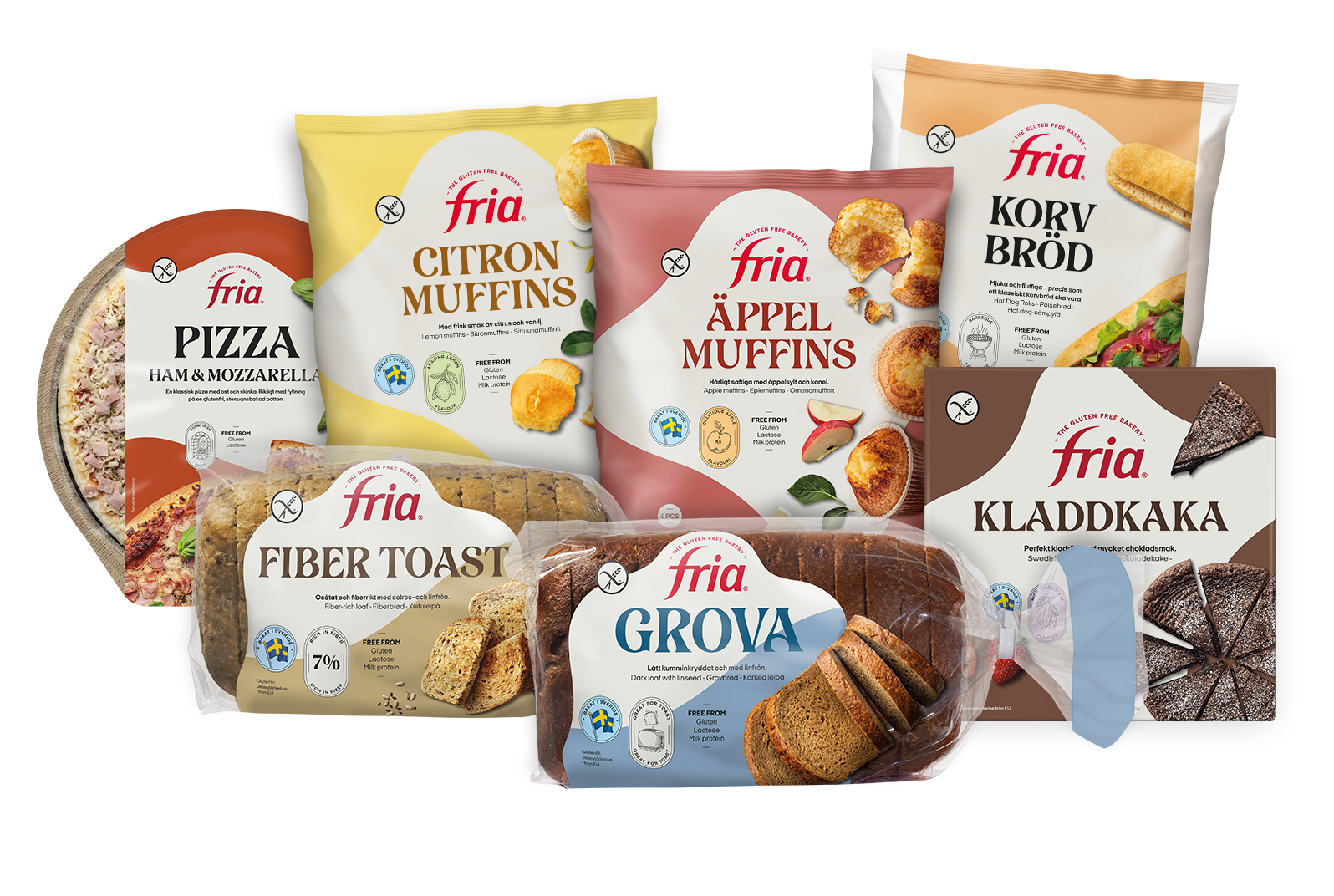



We believe in gluten-free goodness in every bite
As recently as the 1990s, there was hardly anything that could be called a gluten-free bakery. In fact, the selection for people with gluten intolerance was extremely limited.
ABOUT 2% OF SWEDES HAVE CELIAC DISEASE
Learn more about celiac disease and symptoms
Celiac disease is a condition in which you cannot tolerate gluten. Gluten is a collective name for proteins found in the grains wheat, rye, and barley. Celiac disease—sometimes referred to as gluten intolerance—is an autoimmune disease. This means that the immune system attacks the body’s own healthy cells.
Follow us on Instagram for the latest news
FAQ
Do you have any questions about our products, gluten, or celiac disease? Here you can find answers to the most frequently asked questions about Fria right now. Can’t find the question and answer you’re looking for? Then get in touch with your question directly to our customer service and we’ll be happy to help!
Do you have any low-sugar products?

Several of our products have a low sugar content (<5%):
Havrebräck, Havre, Havrefralla, Fiber Toast, Grov Minibaguette, Vita Toast, Vallmofralla, Minibaguette, Lantbröd, Hamburgerbröd, Korvbröd, Surdegsruta, Pizza Ham & Mozzarella, and Grovt Surdegsbröd.
I’m looking for a gluten-free bread that’s tasty and healthy, with a high fiber content. Do you have that?
All of our everyday breads are good sources of dietary fiber, meaning they contain more than 3 g of fiber per 100 g. Our highest-fiber bread is Grovt Surdegsbröd, which contains 11.5% fiber. Other good high-fiber choices (over 6%) are Lingon & Tranbär, Fiber Toast, and Grov Minibaguette.
The ingredient list says “gluten-free wheat starch.” Is it really gluten-free?
Gluten-free wheat starch is produced by washing gluten out of wheat flour. This separates the water-insoluble gluten from the starch. The washing process is so thorough that only starch remains, containing a maximum of 20 mg of gluten per kg. This type of wheat starch is approved for use in the production of gluten-free products under the Codex Alimentarius standards (approved in the EU, Canada, and the USA). The limit of 20 ppm (parts per million), or 20 mg/kg, for gluten-free products is the same regardless of whether the product is made from wheat starch, corn, rice, or something else. We set high requirements for our suppliers, and the purity of the wheat starch is continuously monitored through ongoing analyses. Final products are also tested to ensure that the gluten content in our products stays below the limit. So far, these analyses have shown that we are always well below the limit in all of our products.
In the Nordic countries and the UK, people with celiac disease have eaten products with gluten-free wheat starch for over 50 years, and several scientific studies have shown that the small intestine heals just as well with as without gluten-free wheat starch. However, there are a small number of people with celiac disease who do not tolerate wheat starch, and neither we nor experts can fully explain why. The best guess is that it involves sensitivity to some other substance in wheat that can cause similar symptoms.
How should I store the bread after I’ve thawed it?
After thawing, the bread keeps its best quality at room temperature in a sealed bag. We do not recommend storing the bread in the refrigerator, as bread stales fastest between 0 and +10°C.
Do your products contain milk in any form?
Most of our products are free from milk and are produced in an environment free from lactose and milk protein. Only our ready-made Ham & Mozzarella pizza is topped with lactose-free cheese that contains milk protein. The pizza is produced in separate facilities from our other products to avoid cross-contamination.
Here’s where you can buy our gluten-free products