
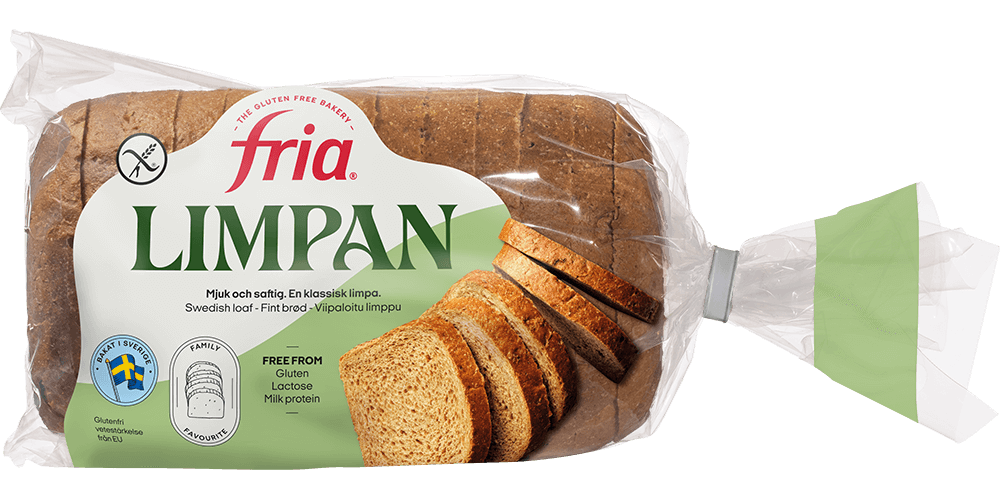
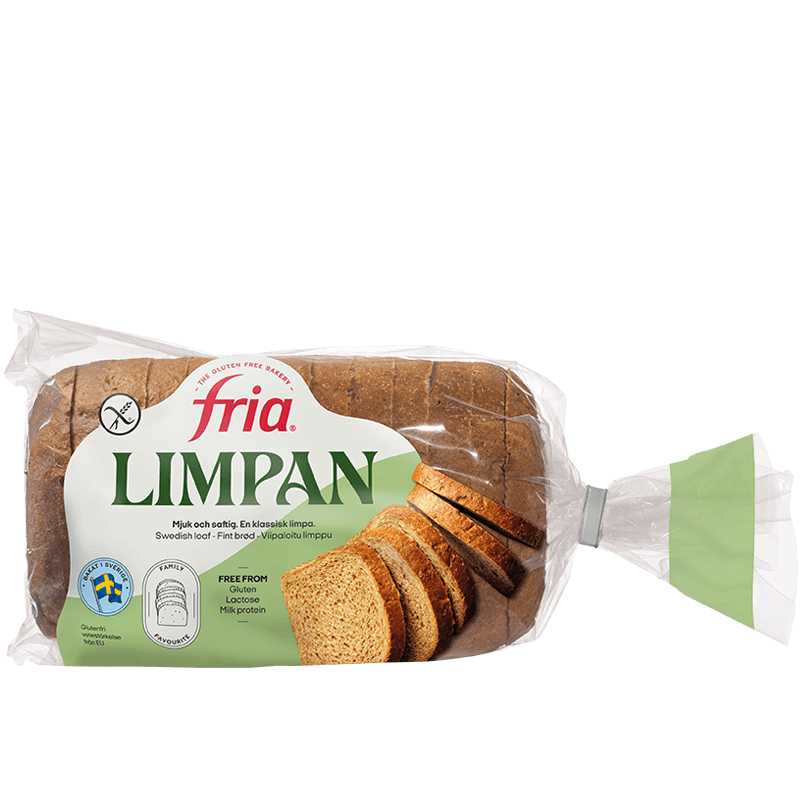
Gluten-free Swedish loaf
Limpan
A classic on the Swedish breakfast table. A soft gluten-free loaf, lightly spiced with Seville orange.
Weight: 500 g
–13 slices
Ready baked
Deep frozen
Our tasty gluten-free Swedish loaf can be enjoyed by the whole family, and has been a staple gluten-free Swedish loaf has been a staple of our range since our bakery opened in the mid-90s. The popularity of our gluten-free Swedish loaf isn’t too difficult to understand – after all, who doesn’t love a classic sandwich with all their favourite fillings? Our gluten-free Swedish loaf is great for breakfast and as a snack.

Gluten-free swedish loaf in the freezer
The bread is frozen immediately after baking. This guarantees bread that is still fresh when you decide to thaw it. Our loaf is ready sliced, so you don’t need to take out and thaw any more than you intend to eat.
Ingredients
Gluten free wheat starch, water, syrup, yeast, gluten free malt extract (barley), thickeners (cellulose gum, guar gum, xanthan gum), rapeseed oil, maltodextrin (corn), psyllium husk, apple fiber, sugar beet fiber, Seville orange, emulsifiers (lecithin [rapeseed], monoand diglycerides of fatty acids [veg.]), corn starch, salt, flavourings. May contain traces of eggs.
Please note that the information on the packaging always applies.
Fodmap friendly certified
Our product has been tested and certified low FODMAP by FODMAP Friendly. It is therefore suitable for people following a low-FODMAP diet.
Standard portion: 1 slice (38 g). Maximum intake according to the low-FODMAP diet: 1 slice.
Nutritional value
Energy
1150 kJ / 270 kcal
Fat
3,7 g
of which saturated fat
0,6 g
Carbohydrates
56 g
of which sugars
9,4 g
Fibre
4,7 g
Protein
0,9 g
Salt
1,3 g

WHAT IS GLUTEN?
Learn more about gluten
In everyday language, gluten is a collective term for some of the proteins found in the cereals wheat, rye, and barley. Gluten also occurs in varieties and hybrids of wheat, rye, and barley – including spelt (also called dinkel or spelt), durum wheat, emmer wheat, and rye wheat. Gluten is therefore present in many popular foods, especially bread and baked goods. It can also be added to various other foods, such as meat products, soups, and ready-made meals. A person with celiac disease must therefore always read the ingredient list on food products. It is now easier to do so because gluten-containing ingredients are required to be highlighted.