
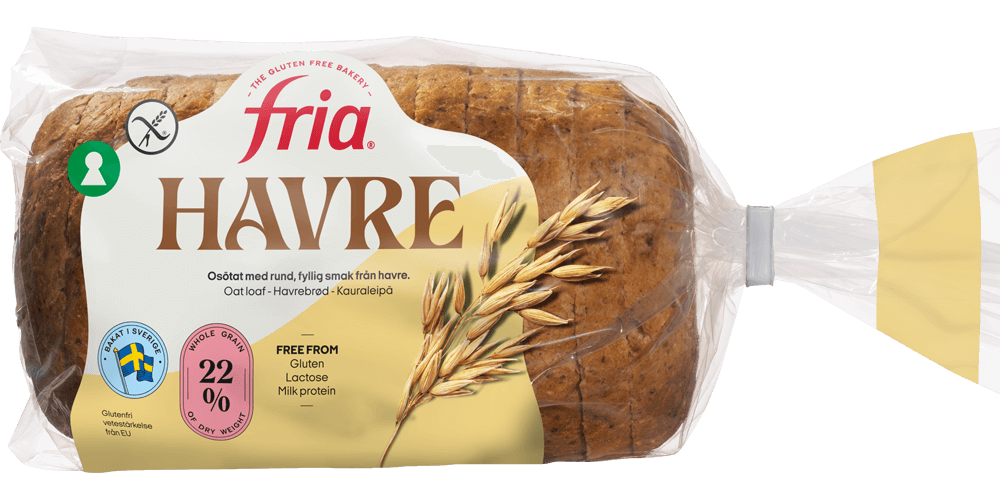
Gluten-free oat bread
Havre
A gluten-free oat bread rich in fibre and baked with pure, gluten-free whole oats. Unsweetened with a rounded and full flavour.
Weight: 500 g
–13 slices
Ready baked
Deep frozen
The many qualities of gluten-free oats make them the perfect component of a gluten-free diet. Adding oats to the bread increases the quantity of whole grains, vitamins, and minerals, while also making it even tastier.

Keyhole-labelled gluten-free oat loaf
Our Oat Loaf is an unsweetened, keyhole-labelled, gluten-free oat bread with 6,1% fibre. The keyhole is a guarantee that the product is lower in sugar and salt, and contains more fibre and whole grains.
Ingredients
Gluten free wheat starch, water, gluten free whole grain oat flakes (13%), gluten free malt extract (barley), thickeners (cellulose gum, guar gum, xanthan gum), maltodextrin (corn), syrup (only as yeast nutrient), yeast, rapeseed oil, psyllium husk, corn starch, emulsifiers (lecithin [rapeseed], mono- and diglycerides of fatty acids [veg.]), salt, flavourings. Whole grain content 13%, equivalent to 22% of dry weight. May contain traces of eggs.
Please note that the information on the packaging always applies.
Fodmap friendly certified
Our product has been tested and certified low FODMAP by FODMAP Friendly. It is therefore suitable for people following a low-FODMAP diet.
Standard portion: 1 slice (38 g). Maximum intake according to the low-FODMAP diet: 7 slices.
Nutritional value
Energy
1000 kJ / 240 kcal
Fat
3,4 g
of which saturated fat
0,7 g
Carbohydrates
46 g
of which sugars
3,6 g
Fibre
6,1 g
Protein
2,2 g
Salt
1,0 g

WHAT IS GLUTEN?
Learn more about gluten
In everyday language, gluten is a collective term for some of the proteins found in the cereals wheat, rye, and barley. Gluten also occurs in varieties and hybrids of wheat, rye, and barley – including spelt (also called dinkel or spelt), durum wheat, emmer wheat, and rye wheat. Gluten is therefore present in many popular foods, especially bread and baked goods. It can also be added to various other foods, such as meat products, soups, and ready-made meals. A person with celiac disease must therefore always read the ingredient list on food products. It is now easier to do so because gluten-containing ingredients are required to be highlighted.